hybrid architectures
Learned policies and classical loops in the same control stack, each doing the part it's best at. Not "RL replaces control" — coordination between them, with the classical layer as a verifiable fallback.
PhD researcher · Automation & Robotics · FERI, University of Maribor
I combine reinforcement learning with classical control for legged and wheeled-biped robots — hybrid architectures where learned policies and hand-tuned loops work together, not against each other. The current one balances on two wheels using a policy of 5 186 parameters, running on a single microcontroller with no computer on board.
↓ This is not an animation. It's a cart-pole simulation running a real state-feedback controller at 240 Hz. Click the robot to shove it. Then break the controller with the sliders.
Balancing this robot is like balancing a broom standing up on your palm. You can't hold the broom still — you have to keep moving your hand so it stays under the broom. The robot does the same thing with its wheels, hundreds of times per second.
The four sliders are the robot's four little worries:
Set k₃ to zero and it stops caring about falling. It falls. Try it — it's fine, it gets back up.
Single inverted pendulum on a cart, integrated with semi-implicit Euler at 240 Hz:
θ̈ = [ g·sinθ − cosθ·(u + m·l·θ̇²·sinθ)/(M+m) ] / [ l·(4/3 − m·cos²θ/(M+m)) ]
ẍ = (u + m·l·(θ̇²·sinθ − θ̈·cosθ))/(M+m)
The controller is full-state feedback, u = k₁x + k₂ẋ + k₃θ + k₄θ̇,
saturated at ±25 N — the structure an LQR design produces. Note the non-minimum-phase
behaviour: to drive the cart back to the origin, the controller must first steer it
away to lean the body toward home. In "RL-style" mode the same state vector is
fed through a saturating nonlinearity, u = umax·tanh(·) —
a hand-written stand-in that mimics the aggressive, saturation-riding character of
trained policies (it's not a live neural network; the real one is on the robot, and in
the talk below).
01
The field tends to frame learned and classical control as rivals. My research treats them as layers of one architecture: hand-tuned impedance handles what it's provably good at, and reinforcement learning handles what can't be modelled cleanly — contact, impacts, recovery from the unexpected.
Learned policies and classical loops in the same control stack, each doing the part it's best at. Not "RL replaces control" — coordination between them, with the classical layer as a verifiable fallback.
Reward only what actually matters and let balance emerge as an instrumental strategy instead of hand-coding it. The flip side is that a policy will exploit every loophole you leave open — most of my debugging time is spent finding them.
Policies trained with PPO across thousands of parallel environments in Isaac Lab, then deployed on an STM32 — the same class of microcontroller running the classical loops. No offboard compute, no GPU on the robot.
02
A two-wheeled self-balancing robot with articulated legs, built to be dropped, shoved and thrown off things — and to keep balancing anyway. What makes it interesting isn't either loop on its own. It's that the legs are hand-tuned and the wheels are learned, and neither one is told what maneuver to perform.
policy loop · learned
leg impedance · hand-tuned
A wheeled biped is the cheapest possible legged robot that still has the hard problems: it is statically unstable, underactuated, and its contact state changes the moment it leaves the ground. A table drop is a plant-model discontinuity — airborne, the wheel loop has nothing to push against; on impact, states jump. That boundary between regimes is exactly where the learned layer earns its place.
Splitting the machine in two is what makes it tractable. The legs are a spring and a damper with numbers I chose; the wheels are a policy that learned what to do about whatever the legs let through. Neither half needs a model of the other, and only one half needed a GPU.
| leg actuators | CyberGear geared BLDC, MIT mode |
|---|---|
| wheels | DDSM115 direct-drive hub motors |
| IMU | BNO086 (onboard sensor fusion) |
| compute | STM32F446RE — classical loops & policy |
| policy | 13 obs → 2 currents, 5 186 params, 66.7 Hz |
| training | Isaac Lab, PPO, thousands of parallel envs |
| legs | hand-tuned impedance, fixed stance |
03
Simulation is the idealized system. The robot is not. The gap between them is where most of the work actually happens — and the fix turned out not to be a better model of the robot, but refusing to commit to one.
Before randomizing anything, characterize the actual hardware. Twelve nominally identical motors, measured on a bench, have current deadzones spread across 36–78 mA. That spread is the thing to reproduce — not its average.
Each parallel environment draws its own masses, frictions and actuator parameters. The policy never meets the same robot twice, so it can't overfit to one. Read the widths of those ranges, not the names of the parameters.
Domain randomization applied all at once stops the policy learning anything. Applied in stages, each widening the world a little further, it survives the ranges that would have prevented it from ever getting off the ground.
Isaac Lab, MuJoCo and the robot disagree about the same controller — and the simulator you trained in is the one most likely to flatter you. If the score comes from the same physics that produced the policy, it isn't evidence.
Three policies, each differing from the previous one in a single respect, tested on the real robot rather than in the simulator that trained them.
| variant | network | actuators | RMS pitch on hardware |
|---|---|---|---|
| A | MLP, 5 186 params | point estimate | did not start |
| B | MLP, 5 186 params | range randomized | 5.04° |
| C | GRU, 23 618 params | range randomized | 2.42° |
A vs B isolates actuator randomization; B vs C isolates the recurrent policy. The policy trained against a single best-guess actuator model never started on hardware at all — its fall detector inhibited actuation before the first stage. Randomizing around the measured actuators is what transfers.
04
A legged robot, trained the same way, kept deliberately separate — it's where I test whether a reward that worked on two wheels means anything on four legs. Mostly it's where I learn how creatively a policy will cheat.
Those two clips are the whole lesson, and the scoreboard has them the wrong way round. The upright gait on the left comes from an older reward function and scores 46.53. Two policies trained on the newer reward beat it — 51.86 and 54.10 — and they get there by crouching to 42% and 34% of standing height. The better network did not learn to stand up straighter; it got better at finding the crouch.
Nothing in that reward ever said standing up was the point, so nothing made it worth doing. You specify; it negotiates. Every reward term is a loophole until proven otherwise — and the policy that looks right to you may be the one your own metric ranks last.
05
Control theory isn't only for robots. One of my first projects, years ago, was an MQTT plant monitor — so here is a plant with a proper PID controller on its watering pump. The sun rises and sets, the soil dries out, and the controller tries to hold the moisture you ask for. Tune it badly and you can drown the poor thing.
The pump has three feelings about the thirsty plant:
Crank Ki way up and watch the pump get so impatient it floods the pot, then sulks, then floods it again. That's called integral windup, and real engineers fight it every day.
06
Before the wheels, an arm. My mechatronics diploma thesis: a fully 3D-printed 4-DOF manipulator, designed, simulated, built and controlled end-to-end — with a machine-vision demo where the end effector follows your hand in real time.
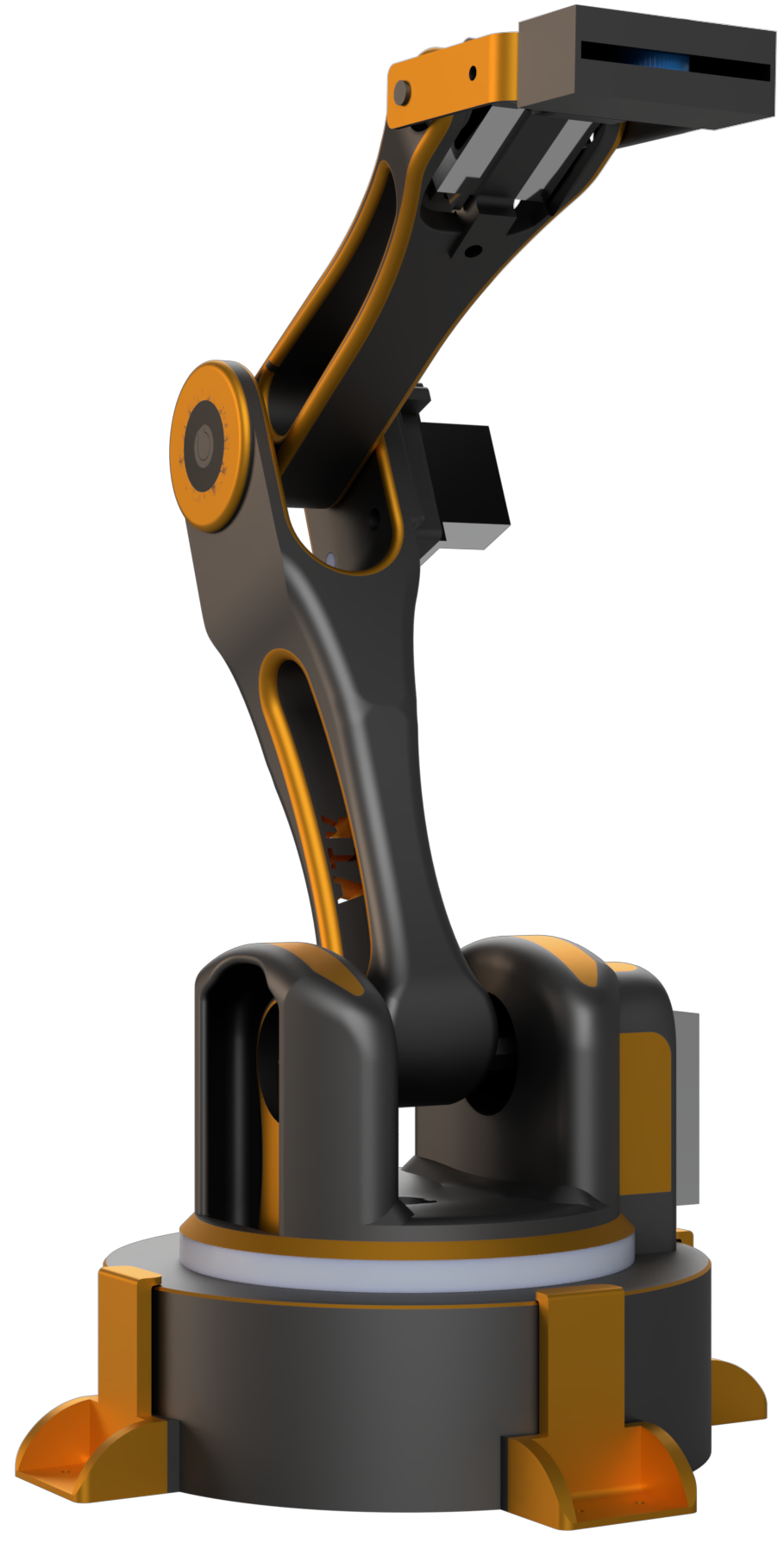
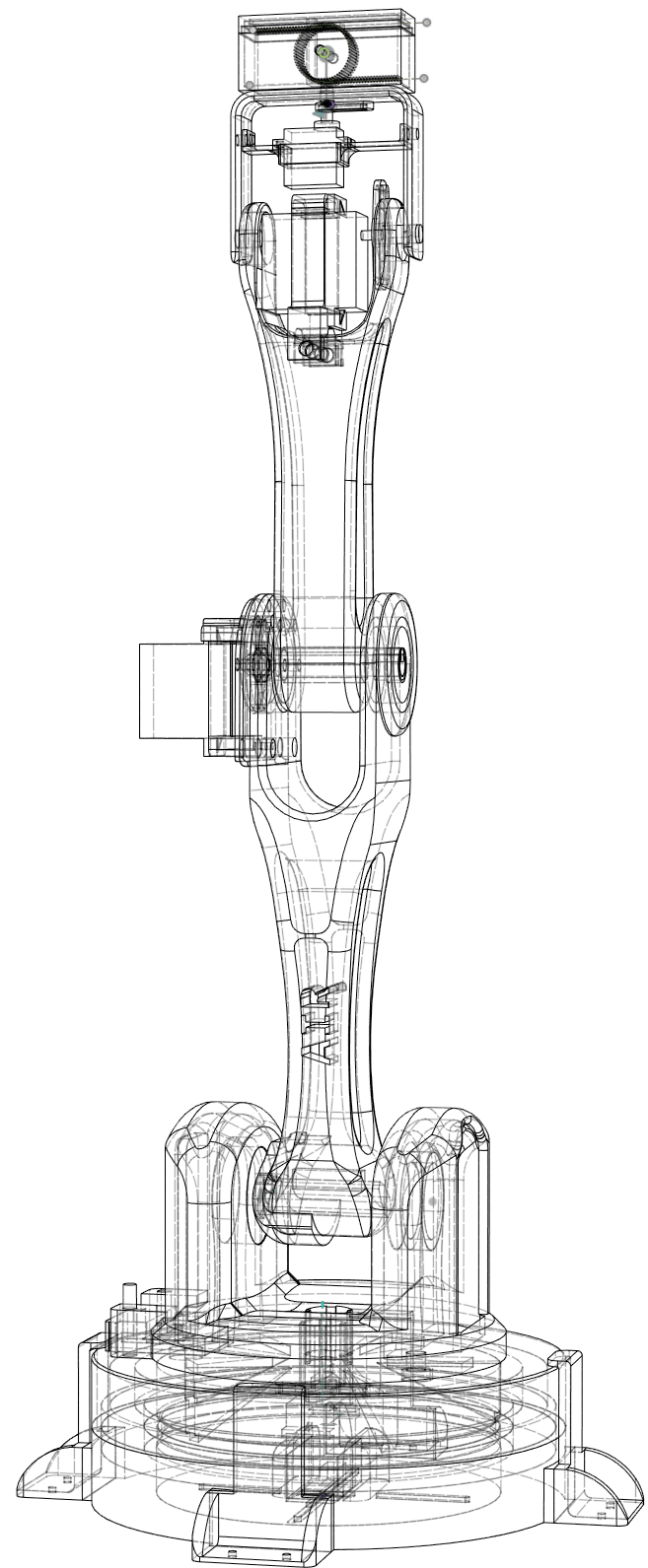
Custom point-to-point and linear moves with quadratic, cubic and sinusoidal acceleration profiles — written from scratch, not taken from a library.
Inverse and forward kinematics via the Robotics Toolbox for Python; kinematic validation in MSC Adams, structural FEM validation in Fusion 360.
A custom UART protocol between the Python host and the STM32 that drives the joints — the same host/microcontroller split the wheeled biped uses today.
YOLO models trained for object detection, and a MediaPipe hand-tracking demo where the arm's end effector mirrors the user's hand live.
07
Policy learning for complex maneuvers
Učenje in vgrajena implementacija nevronskega regulatorja za stabilizacijo dvokolesnega robota z zavračanjem motenj (Learning and embedded implementation of a neural controller for disturbance rejection in a two-wheeled self-balancing robot)
Diferenčno vodenje agilnega dvokolesnega mobilnega robota (Differential control of an agile two-wheeled mobile robot)
08
Junior researcher (mladi raziskovalec) at the Faculty of Electrical Engineering and Computer Science, University of Maribor. Happy to talk about hybrid control, wheeled bipeds, reward design, or why your robot keeps falling over.